AI Train Booking: How ConfirmTkt and Smart Travel Technology Are Changing Railway Reservations
Artificial intelligence is changing how people search for information, make decisions and use digital services. Travel is one of the industries where intelligent technologies can make complex processes easier to understand.
Planning a railway journey involves searching for trains, comparing schedules, checking availability, selecting a suitable class, completing reservations and monitoring booking status. For travellers dealing with waitlisted tickets or limited availability, the process can become even more complicated.
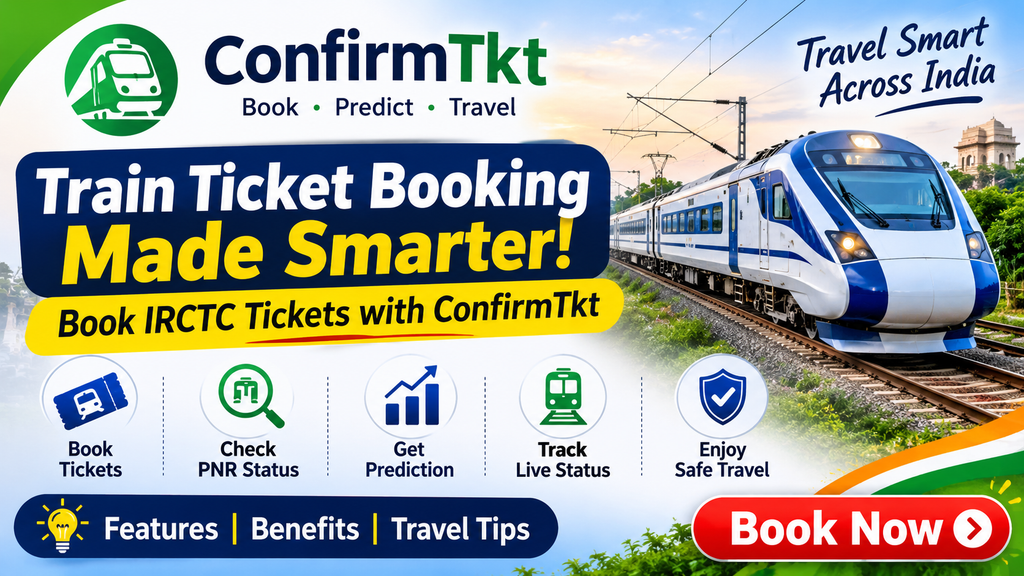
Modern digital travel platforms are introducing features designed to make travel planning more informative and convenient. ConfirmTkt, an online train booking platform, provides features such as PNR confirmation prediction, AI Seat Finder, Same Train Alternates, train schedule information and live train running status.
These tools illustrate how technology can help travellers make more informed decisions.
This article explores AI in train booking, how prediction tools may work conceptually, the role of data in travel planning, ConfirmTkt features, the difference between prediction and confirmation, digital booking workflows, limitations of AI travel tools and the future of intelligent railway travel.
What Is AI Train Booking?
AI train booking refers to the use of artificial intelligence, machine learning, predictive analytics or other intelligent computational techniques to improve the train booking experience.
Traditional online booking systems primarily allow passengers to search for journeys, select available trains, enter passenger details and complete payment.
AI-enabled or data-driven features may extend these capabilities by helping users interpret information, discover options or estimate outcomes.
Examples of possible applications include:
- Analysing historical reservation patterns.
- Estimating the likelihood of ticket confirmation.
- Suggesting alternative booking options.
- Helping passengers discover seat availability.
- Supporting personalised search experiences.
- Improving travel recommendations.
- Identifying patterns in demand.
- Providing information that helps users make decisions.
AI does not replace the railway reservation system.
The official booking system determines the reservation status according to applicable railway rules and actual availability.
Intelligent tools may provide recommendations, estimates or additional information that support the user’s decision-making process.
Why AI and Data Analytics Matter in Travel
Travel decisions frequently involve several variables.
A passenger may have a preferred departure time, a limited budget, a specific destination station, a preferred travel class and a fixed date.
When multiple trains are available, comparing every option manually may take time.
Data-driven travel tools can help organise information and make it easier to explore relevant options.
1. Analysing Historical Patterns
Historical data can be useful when studying patterns in train bookings.
For example, reservation activity may vary depending on the day of the week, season, route, holiday period and demand.
Predictive models may use historical patterns to estimate possible outcomes.
However, past patterns cannot perfectly predict future circumstances.
Unexpected changes in demand, cancellations, operational conditions or booking activity can influence actual availability.
2. Supporting Better Decisions
Travel platforms can present information in ways that help users compare choices.
Instead of simply showing a train name, a platform may provide availability information, alternative options or estimates that help passengers evaluate their plans.
The objective is not necessarily to make every decision automatically.
A useful intelligent system can help a traveller understand available information while allowing the traveller to choose the option that best fits their requirements.
3. Reducing Information Complexity
Railway travel information can involve many details:
- Station names and station codes
- Departure times
- Arrival times
- Intermediate stops
- Journey duration
- Travel class
- Seat availability
- Reservation status
- Fare
- Cancellation conditions
Technology can make this information easier to access and interpret.
A well-designed booking interface reduces the need to navigate multiple information sources unnecessarily.
ConfirmTkt and AI-Powered Railway Travel Features
ConfirmTkt provides several digital features associated with train booking and journey planning.
The supplied website information describes PNR confirmation prediction, AI Seat Finder, Same Train Alternates, train schedules, live running status and booking-related services.
These features serve different purposes.
PNR Confirmation Prediction
PNR confirmation prediction is designed to estimate the probability of a waitlisted ticket becoming confirmed.
A passenger who books a waitlisted reservation may want to understand the likelihood of receiving a confirmed booking before departure.
Prediction tools may help interpret historical trends and booking-related information.
According to the ConfirmTkt information supplied, its algorithm predicts PNR confirmation using historical trends.
A prediction should be understood as an estimate rather than a final booking decision.
Actual confirmation depends on the reservation system and the movement of available seats.
AI Seat Finder
AI Seat Finder is described as a feature that helps users find available seats or booking options for their preferred train.
The purpose of such a tool is to help passengers explore availability and potentially discover options they may otherwise overlook.
Availability can change quickly.
A suggested option should therefore be verified through the actual booking process before the passenger makes a decision.
Same Train Alternates
Same Train Alternates is a feature designed to explore alternative boarding or dropping points on the same train.
This may help passengers investigate different combinations when their preferred segment has limited availability.
The feature demonstrates how digital tools can help travellers explore additional possibilities instead of repeatedly checking only one station combination.
Travellers should ensure that any selected boarding and destination arrangement accurately reflects their journey.
Train Schedule Information
Train schedule information provides details about routes, stations and planned timings.
This data supports travel planning and allows passengers to compare journey options.
A schedule is different from live running status because operational conditions may affect the actual movement of a train.
Live Train Running Status
Live train running status provides updates related to train movement.
Travellers may use this information to monitor progress and plan station arrival times.
This is particularly useful when coordinating with family members, arranging pickups or planning onward transport.
How Ticket Confirmation Prediction Works: A Conceptual Explanation
The exact technical architecture of a particular platform’s prediction system may not be publicly available.
However, predictive analytics systems generally work through a series of conceptual steps.
Step 1: Collect Relevant Historical Information
A prediction model may be developed using historical data relevant to the outcome it is intended to estimate.
For a reservation prediction problem, historical booking patterns may provide information about how reservation statuses changed over time.
The availability of appropriate data is important because the quality of a prediction depends partly on the relevance and reliability of the information used.
Step 2: Identify Patterns
A predictive model may analyse patterns within historical information.
For example, a model may examine how different booking situations have changed under different circumstances.
Pattern recognition can help identify relationships that are not immediately obvious when examining individual records.
Step 3: Generate an Estimate
Based on the patterns it has learned, a predictive system may generate an estimate for a particular situation.
The estimate may be expressed as a probability, prediction category or other indicator.
A prediction is not the same as a guaranteed outcome.
Step 4: Present Information to the User
The platform can display its estimate in a way that helps the passenger understand the booking situation.
The user may then decide whether to continue monitoring the booking, explore alternatives or make other travel arrangements.
Step 5: Compare Predictions With Actual Outcomes
Predictive systems can be evaluated by comparing estimates with actual outcomes.
Such evaluation can help determine how useful predictions are over time and whether the model requires improvement.
This is an important part of responsible predictive technology.
Prediction Versus Actual Railway Reservation Status
One of the most important concepts passengers should understand is the difference between a prediction and an official reservation status.
Prediction
A prediction estimates what may happen.
It may use historical patterns, statistical analysis or other computational techniques.
Its accuracy can vary depending on the circumstances.
Actual Status
The actual reservation status reflects the booking information available through the applicable reservation system.
The booking status may change over time as reservations are processed.
Why This Difference Matters
A passenger should never treat an estimated confirmation probability as a guaranteed reservation.
For example, if a passenger receives a favourable prediction, that does not mean they automatically have a confirmed berth.
The actual ticket status must be checked separately.
This distinction is important when planning hotel reservations, onward flights, event attendance or other commitments that depend on a confirmed train journey.
The Role of Data in Intelligent Travel Planning
Data is a central component of digital travel systems.
Travel platforms may process or display different types of information depending on the services they offer.
Schedule Data
Schedule data helps passengers understand planned train movement, station stops and journey timing.
It supports search, comparison and travel planning.
Availability Data
Seat availability information helps travellers understand which booking options may be available.
Availability is time-sensitive and can change.
Reservation Status Data
Reservation status information allows passengers to monitor booking progress.
This is particularly important for waitlisted or RAC reservations.
Route Data
Route information helps users understand which stations a train serves.
It can support travel planning and alternative station searches.
Historical Information
Historical patterns may be useful for analytical or predictive applications.
However, historical information should not be interpreted as certainty about future outcomes.
How Intelligent Travel Platforms Improve the Booking Journey
The train booking journey can be divided into several stages.
Technology may support each stage differently.
Stage 1: Travel Search
Passengers begin by selecting their source, destination and travel date.
Search systems help organise the available train options.
Stage 2: Train Comparison
Travellers compare schedules, journey duration, travel classes and availability.
Information presented in a clear format can make this process easier.
Stage 3: Booking Decision
The passenger selects a suitable train.
Additional information, such as alternative options or prediction tools, may help the passenger evaluate the decision.
Stage 4: Passenger Information
Passengers enter the required details and booking preferences.
Accurate information is important to avoid unnecessary booking problems.
Stage 5: Payment and Reservation
The booking process proceeds through the required payment and authentication steps.
The reservation system determines the actual booking outcome.
Stage 6: Post-Booking Monitoring
After booking, passengers may monitor PNR status and train running status.
Digital notifications and status tools can help travellers stay informed.
AI and Personalised Travel Recommendations
Personalisation is another possible application of intelligent travel technology.
A travel platform may help users discover options based on preferences or information they provide.
For example, a traveller may prefer:
- Morning departures
- Shorter journey duration
- Specific travel classes
- Particular railway stations
- Lower fares
- Direct journeys
Recommendation systems can help prioritise relevant options.
However, personalised recommendations should remain transparent and allow users to review the alternatives.
The best travel option is not always the option ranked first by a system.
Passengers should consider their own requirements before booking.
The Benefits of AI-Enabled Train Booking Tools
Faster Information Discovery
Digital tools can make information easier to discover.
Passengers may be able to review multiple options without manually comparing every detail.
More Informed Booking Decisions
Prediction and availability-related information may help travellers understand their options.
This is particularly relevant when a preferred train has limited availability.
Alternative Exploration
Features such as Same Train Alternates may help passengers explore different booking combinations.
Better Journey Monitoring
Train running status and reservation updates can help passengers remain informed after booking.
More Convenient Digital Travel
A platform combining booking, schedule information, PNR status and additional tools may reduce the need to switch between different services.
Limitations of AI in Train Booking
AI and predictive analytics are useful tools, but they have limitations.
Predictions Can Be Incorrect
Historical patterns do not guarantee future outcomes.
A prediction may be inaccurate when circumstances change unexpectedly.
Availability Is Dynamic
Seat availability can change because of bookings, cancellations and reservation adjustments.
A result displayed earlier may no longer be available when the passenger proceeds to book.
Operational Conditions Can Change
Train movement may be affected by operational conditions.
Schedule information and live updates should be reviewed when planning a journey.
Recommendations May Not Match Personal Preferences
An automated recommendation may not account for every passenger requirement.
Travellers should review the details rather than blindly following a suggestion.
Technology Does Not Replace Railway Rules
AI tools do not override applicable railway reservation policies.
Passengers should verify current booking conditions and eligibility requirements.
How Travellers Can Use Prediction Tools Responsibly
Intelligent travel tools are most useful when passengers understand their limitations.
Check the Actual PNR Status
Always verify the current reservation status.
Keep Alternative Travel Plans
If your journey is important, explore alternative trains or other travel arrangements where practical.
Avoid Making Decisions Based Only on Predictions
A favourable estimate does not guarantee a confirmed ticket.
Verify the Final Availability
Before completing a reservation, review the actual availability displayed during booking.
Understand the Conditions
Review fare, cancellation terms and other applicable booking requirements.
The Future of AI in Railway Travel
The future of intelligent travel technology may involve increasingly sophisticated search, recommendation and information systems.
Potential areas of development include:
- More personalised journey recommendations.
- Improved travel search experiences.
- Better information presentation.
- More intelligent availability discovery.
- Automated travel planning assistance.
- Integrated journey information.
- Improved notification experiences.
- Data-driven travel insights.
These are potential developments rather than guarantees about specific products or services.
The broader direction of digital travel is toward making information more accessible and helping users make better-informed decisions.
Frequently Asked Questions
What is AI train booking?
AI train booking refers to the use of artificial intelligence or predictive technologies to improve train search, booking assistance, recommendations, availability discovery or travel planning.
Does ConfirmTkt use AI?
The supplied ConfirmTkt information describes an AI Seat Finder and an algorithm-based PNR confirmation prediction feature. The precise technical details of the system are not provided in the source.
What is PNR confirmation prediction?
PNR confirmation prediction is an estimate of the possibility that a waitlisted booking may become confirmed.
Is PNR prediction guaranteed?
No. A prediction is an estimate. The actual reservation status is determined through the applicable railway reservation system.
What is AI Seat Finder?
AI Seat Finder is described as a tool that helps travellers discover available seat options for their preferred train.
What is Same Train Alternates?
Same Train Alternates helps users explore alternative boarding or dropping points on the same train as an availability-related option.
Can AI guarantee a confirmed railway ticket?
No predictive tool can guarantee a confirmed ticket simply by estimating the outcome. The actual reservation status must be checked.
How does data analytics help railway travellers?
Data analytics may help identify patterns, organise information, support recommendations and provide estimates that assist travellers in making decisions.
Why should travellers check actual PNR status?
Actual PNR status reflects the current reservation information and is more important for making final travel arrangements than a prediction.
Does AI replace IRCTC?
AI-related features support information discovery or decision-making. Railway reservations still operate according to the applicable reservation system and rules.
What are the advantages of intelligent booking tools?
They may help users discover options, interpret information, monitor booking status and make more informed travel decisions.
Can predictive models make mistakes?
Yes. Predictions can be affected by changing conditions, incomplete information, unexpected demand and other factors.
Is live train running status the same as a train schedule?
No. A schedule describes planned timing and route information, while running status provides updates about the train’s movement.
How can AI improve travel planning?
AI may help with personalised recommendations, information discovery, option comparison, prediction and other travel-planning tasks.
Conclusion
Artificial intelligence and data-driven technology are becoming increasingly relevant to digital travel services.
Train booking platforms can use intelligent features to help passengers explore availability, understand reservation information and make better-informed decisions.
ConfirmTkt’s features, including PNR confirmation prediction, AI Seat Finder, Same Train Alternates, train schedule information and live running status, illustrate different ways digital tools can support the railway travel experience.
However, technology should be used as a decision-support tool rather than a substitute for checking actual booking details.
Passengers should always verify their reservation status, review the final booking information and follow the applicable railway rules.
The most useful travel technology is technology that helps people understand their choices, plan more efficiently and make decisions with greater confidence.